RepMold: Modern Mold Replication and Manufacturing
RepMold is an emerging term associated with modern approaches to creating, reproducing, repairing, and improving molds. It is increasingly discussed alongside technologies such as computer-aided design (CAD), 3D scanning, 3D printing, CNC machining, rapid prototyping, and digital manufacturing.
However, RepMold is not a universally standardized manufacturing process with one fixed definition. Different discussions use the term to describe slightly different approaches to mold replication and digital tooling. A useful way to understand it is as an umbrella concept for workflows that make it easier to reproduce or rebuild molds by combining traditional molding knowledge with modern digital tools.
This distinction is important because RepMold should not be confused with a single machine, material, or patented production system. Moreover, its value comes from how several established technologies can work together to make mold development more flexible and efficient.
What Is RepMold?
RepMold can generally be understood as a mold replication or rebuilding approach designed to reproduce an existing shape, mold, component, or digital design.
The process may begin with an existing physical part, an old mold, a master pattern, or a computer-generated model. Digital tools can then be used to capture dimensions, recreate geometry, modify the design, and prepare the information for manufacturing.
Depending on the project, the resulting mold may be produced through additive manufacturing, CNC machining, casting, or a combination of techniques.
The basic objective is straightforward: create a usable and accurate mold without unnecessarily repeating every step involved in developing completely new tooling.
Why Is RepMold Becoming Relevant?
Traditional mold manufacturing can require considerable engineering, machining, testing, and finishing work. For complex tooling, even a relatively small design change can require additional development and production time.
Modern manufacturing environments increasingly demand faster product development. Designers may need several prototypes before reaching a final design, while manufacturers may need replacement tooling when an older mold becomes damaged or unavailable.
Digital workflows can help address these challenges.
Instead of relying entirely on physical measurements and manual recreation, a manufacturer can capture information digitally and use that information as the foundation for a new mold or replacement component.
This can be particularly useful when an original design file is unavailable.
How Does a RepMold Process Work?
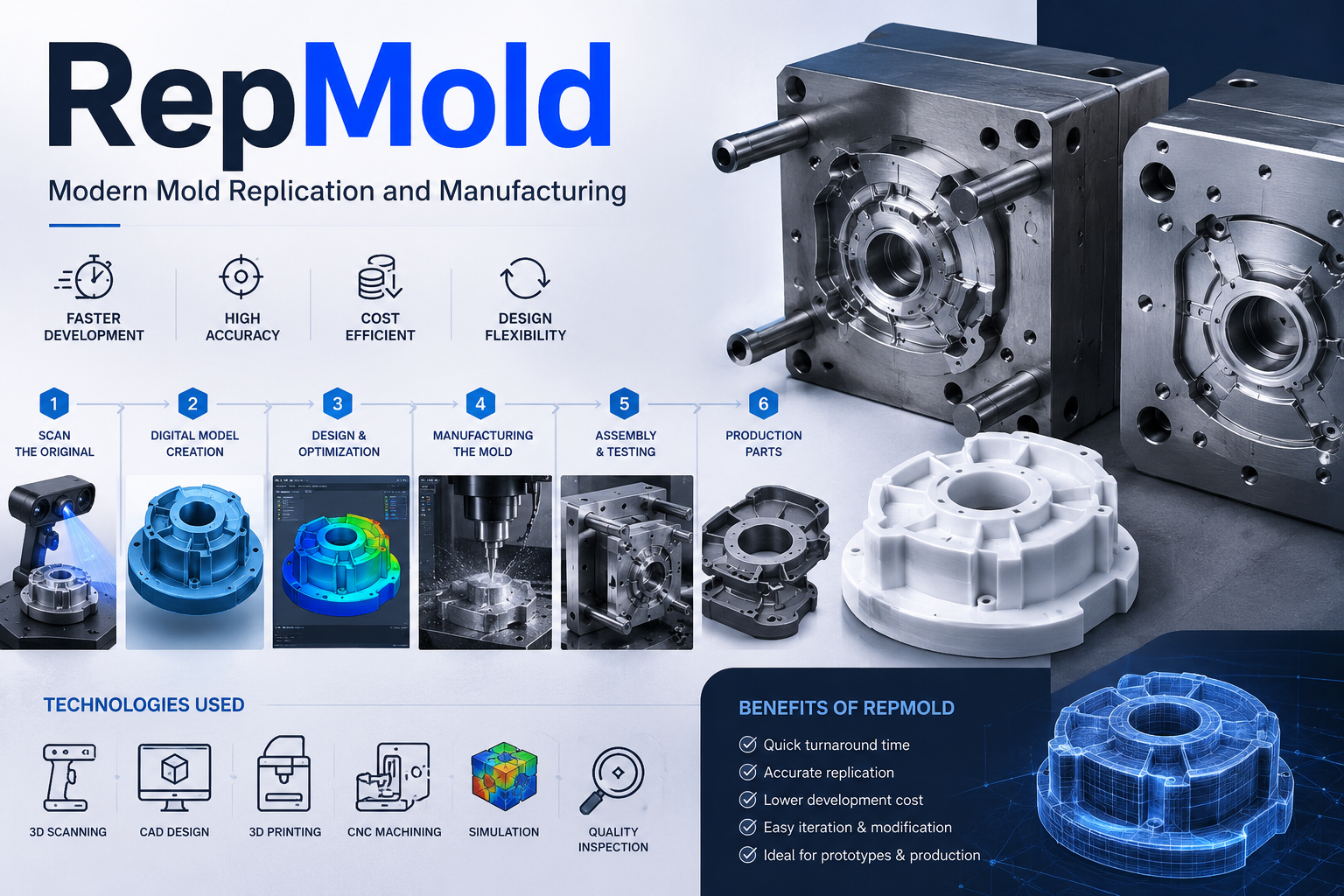
There is no single RepMold workflow because the exact process depends on the material, application, required accuracy, and manufacturing method. A typical digital replication workflow can include several stages.
1. Examine the Original
The first step is understanding what needs to be reproduced.
This could be:
- An existing mold
- A finished component
- A damaged tool
- A master pattern
- A physical prototype
- An existing CAD model
The condition of the original object matters because damage, wear, deformation, or missing details can affect the final result.
2. Capture the Geometry
If a digital model already exists, it can become the starting point for manufacturing.
When no suitable model is available, manufacturers may use measurement equipment or 3D scanning to capture the physical geometry.
Scanning can create a digital representation of complicated surfaces that would otherwise be difficult to reproduce manually.
The resulting data usually requires inspection and cleanup before it can be used effectively.
3. Build or Correct the Digital Model
Raw scanning data is not necessarily ready for manufacturing.
Moreover, engineers may need to remove unwanted points, repair gaps, smooth surfaces, correct distortions, and establish the dimensions required for production.
CAD software can also be used to make deliberate changes. For example, an engineer might modify wall thickness, add draft angles, strengthen a section, or compensate for expected material shrinkage.
This stage is where replication can become more than simple copying.
4. Prepare the Mold Design
The digital model must be converted into a suitable mold design.
Depending on the application, this may involve creating cavities, cores, parting surfaces, vents, gates, supports, or other tooling features.
Material behavior also needs to be considered. A mold designed for one manufacturing process may not be appropriate for another.
5. Manufacture the Tool
Once the design has been validated, the physical mold can be produced.
Possible manufacturing methods include:
- 3D printing
- CNC machining
- Casting
- Resin tooling
- Silicone molding
- Metal tooling
- Hybrid manufacturing
The best option depends on the required production volume, durability, precision, surface finish, and budget.
6. Test and Inspect
The first manufactured mold should not automatically be treated as production-ready.
Testing can reveal dimensional errors, surface problems, poor fit, shrinkage effects, or other issues.
A test part can be compared with the intended dimensions to determine whether adjustments are required.
This validation stage is especially important when the mold will be used for functional components rather than simple visual prototypes.
RepMold and Traditional Mold Making
RepMold-style workflows do not necessarily replace traditional tooling.
Instead, they can complement conventional manufacturing.
Traditional molds made from durable metals remain highly valuable when manufacturers need long service life and large production quantities. Such tooling can justify its initial investment when the same component will be produced repeatedly over an extended period.
Digital replication approaches can become more attractive when flexibility and development speed are more important.
| Factor | Traditional Tooling | RepMold-Style Workflow |
| Initial development | Often more extensive | Can be faster for suitable projects |
| Design changes | May require additional tooling work | Digital changes can simplify revisions |
| Prototyping | Can be relatively expensive | Often suitable for rapid iterations |
| High-volume production | Excellent | Depends heavily on mold material |
| Digital archiving | Possible | Central to many workflows |
| Replacement of obsolete parts | Can be difficult | Digital recreation may help |
| Tool durability | Often very high with metal tooling | Depends on manufacturing method |
| Flexibility | Lower after tooling is produced | Generally higher during development |
The choice should therefore be based on the requirements of the individual project rather than assuming one method is always better.
Major Technologies Associated With RepMold
RepMold is best understood through the technologies that can support the workflow.
3D Scanning
3D scanning can capture the shape of an existing physical object and convert it into digital information.
This can be useful when original engineering drawings or CAD files are missing.
CAD Software
Computer-aided design software provides the environment for creating, editing, and preparing digital models.
It allows engineers to reproduce an existing geometry or intentionally improve it before manufacturing.
3D Printing
Additive manufacturing can produce prototype molds, patterns, inserts, and certain production tools directly from digital designs.
Its biggest advantage is flexibility. A design can be modified and printed again without requiring an entirely new conventional machining setup.
CNC Machining
Computer-controlled machining remains important when high dimensional accuracy, durability, and quality surface finishes are required.
A digital model can be converted into machining instructions for producing metal or other tooling materials.
Simulation
Manufacturing simulation can help engineers identify potential problems before producing expensive tooling.
Depending on the application, simulations may examine material flow, cooling, deformation, or other production characteristics.
What Are the Benefits of RepMold?
Faster Development
One of the biggest potential advantages is reducing the time between an existing design and a usable mold.
Digital files can be modified quickly, which can make iterative development more efficient.
Easier Replication
When an accurate digital model exists, reproducing a mold or tooling component can become easier.
Instead of relying entirely on physical measurements, manufacturers can maintain a digital reference for future work.
Lower Prototype Costs
For some applications, producing a conventional production mold immediately may be unnecessary.
A digitally manufactured prototype tool can provide an opportunity to test the design before investing in permanent tooling.
Greater Design Flexibility
Digital models can be modified without physically rebuilding the entire design.
This makes experimentation easier during early product development.
Support for Older Components
Some industries still depend on parts designed many years ago.
If the original tooling is damaged or unavailable, reverse-engineering a physical component can potentially provide a route toward creating replacement tooling.
Reduced Material Waste in Some Applications
Additive manufacturing can build objects layer by layer rather than removing large quantities of material from a solid block.
However, the environmental benefit depends on the complete production process, including materials, energy use, failed prints, finishing, and eventual disposal.
What Are the Limitations?
RepMold is not a universal solution.
Accuracy Still Depends on the Process
A digital workflow does not automatically guarantee perfect accuracy.
Scanner resolution, measurement errors, model quality, printer capability, machining precision, and material behavior can all influence the final result.
Material Selection Is Critical
A prototype mold made from a relatively soft material may work well for limited testing but may not withstand thousands of production cycles.
Manufacturers must match the tooling material to the intended application.
Shrinkage Can Affect Results
Some molding and casting materials change dimensions as they cool or cure.
If shrinkage is not considered during design, the finished component may differ from the intended dimensions.
Surface Finish May Require Additional Work
A printed mold does not always have the same surface quality as a carefully machined metal tool.
Additional sanding, coating, machining, polishing, or finishing may be necessary.
High-Volume Production May Still Favor Conventional Tooling
For very large production quantities, durable metal tooling can remain the more practical choice.
A faster prototype process does not necessarily translate into a better long-term production solution.
Where Can RepMold Be Used?
Potential applications are broad because mold replication is relevant to many manufacturing sectors.
Automotive Manufacturing
Vehicle manufacturers and suppliers frequently require prototypes, replacement components, tooling inserts, and specialized production parts.
Digital replication can help with development and replacement tooling where appropriate.
Consumer Products
Products such as housings, containers, accessories, and household components often require molds during development and production.
Rapid tooling can allow designers to test several versions before committing to permanent tooling.
Aerospace
Aerospace manufacturing demands extremely high standards, so every application requires careful engineering and qualification. Digital mold development may nevertheless have a role in prototypes, tooling, fixtures, and selected non-critical applications.
Medical Manufacturing
Medical products often require precise shapes and repeatable manufacturing.
However, medical applications can involve strict regulatory and material requirements. A RepMold-style workflow should therefore only be used where the resulting tooling and production process meet the applicable requirements.
Product Development
Startups, engineering teams, and designers can use rapid mold development to evaluate physical products before investing heavily in mass production.
RepMold vs. 3D Printing
RepMold and 3D printing are not the same thing.
3D printing is a manufacturing technology that creates objects layer by layer from digital information.
RepMold, when used as a general manufacturing concept, can incorporate 3D printing but is broader than it. A RepMold workflow might use scanning to capture an existing component, CAD software to modify the design, CNC machining to manufacture a durable insert, and conventional molding to produce the final parts.
In other words, 3D printing can be one tool within a RepMold workflow rather than being the definition of RepMold itself.
RepMold vs. Reverse Engineering
Reverse engineering focuses on understanding and recreating an existing product, component, or system.
RepMold can use reverse-engineering techniques when an existing physical component needs to become a mold or digital model.
The two concepts therefore overlap, but they are not identical.
Reverse engineering may produce a digital design, while a RepMold-style workflow may continue from that design toward physical tooling and repeated production.
Is RepMold a Specific Machine or Product?
Not necessarily.
This is one of the most important points to understand about the term.
Current usage varies, and there is no single universally accepted definition that makes RepMold equivalent to one particular machine, material, or manufacturing system. Some descriptions emphasize replication, while others focus on digital tooling, repair, rapid prototyping, or a combination of these ideas.
Therefore, when evaluating a company or product described as “RepMold,” it is important to examine its actual equipment, materials, workflow, specifications, and intended application rather than relying on the name alone.
The Future of RepMold
The future of digital mold replication is closely connected to broader developments in manufacturing.
More accurate scanners can make physical-to-digital conversion easier. Better additive manufacturing systems can produce stronger and more precise tooling. Improved simulation can help identify design problems before production. Automation can also reduce repetitive engineering tasks.
Artificial intelligence may eventually contribute to areas such as geometry analysis, design optimization, defect detection, and process monitoring. However, AI should be considered a supporting technology rather than automatically assuming that every RepMold workflow is AI-powered.
The larger trend is clear: manufacturing is becoming increasingly digital, and the ability to move efficiently between physical objects and digital models is becoming more valuable.
How to Choose the Right RepMold Approach
There is no single method that works for every project.
Before selecting a workflow, manufacturers should consider:
- What is being replicated?
- How accurate does the final component need to be?
- How many parts will be produced?
- What material will be used?
- How long must the mold last?
- What surface finish is required?
- How quickly is the tooling needed?
- What budget is available?
- Does the process require certification or regulatory approval?
- Can the finished parts be properly inspected and validated?
Answering these questions can help determine whether 3D printing, CNC machining, conventional tooling, casting, or a hybrid approach makes the most sense.
Final Thoughts
RepMold is best viewed as an emerging term connected with mold replication, digital tooling, reverse engineering, rapid prototyping, and modern manufacturing workflows. Rather than being a replacement for every traditional molding method, it represents a way of connecting digital design and physical production more efficiently.
Its greatest potential lies in situations where manufacturers need faster development, easier replication, flexible design changes, replacement tooling, or economical prototypes.
At the same time, RepMold is not a shortcut around engineering fundamentals. Accuracy, material selection, tolerances, surface finish, durability, testing, and production requirements still determine whether a mold will actually perform well.
As digital manufacturing continues to develop, workflows that connect scanning, CAD, simulation, additive manufacturing, machining, and inspection are likely to become increasingly useful. RepMold may remain an informal term, but the manufacturing ideas associated with it are part of a much broader shift toward faster and more digitally connected production.
Frequently Asked Questions: RepMold
1. What is RepMold?
RepMold is an emerging term generally associated with creating, reproducing, repairing, or modifying molds through a combination of digital design and manufacturing techniques. Its exact meaning can vary depending on the context.
2. Is RepMold a type of 3D printing?
Not exactly. 3D printing can be used as part of a RepMold-style workflow, but RepMold is broader and may also involve 3D scanning, CAD, CNC machining, casting, inspection, and conventional molding.
3. Can RepMold replace traditional molds?
In some prototype and short-run applications, digitally produced tooling may reduce the need for conventional tooling. For demanding high-volume production, however, durable traditional metal molds may still be more appropriate.
4. What is RepMold used for?
Potential uses include prototype tooling, mold replication, replacement tooling, reverse engineering, small-batch production, product development, and repairing or recreating older molds.
5. Is RepMold an established technical standard?
No single universally accepted technical definition currently exists for the term. It is better treated as an emerging or informal description of several related manufacturing approaches.
6. What technologies are commonly associated with RepMold?
Depending on the application, a RepMold workflow may involve 3D scanning, CAD software, 3D printing, CNC machining, casting, simulation, measurement, and quality inspection