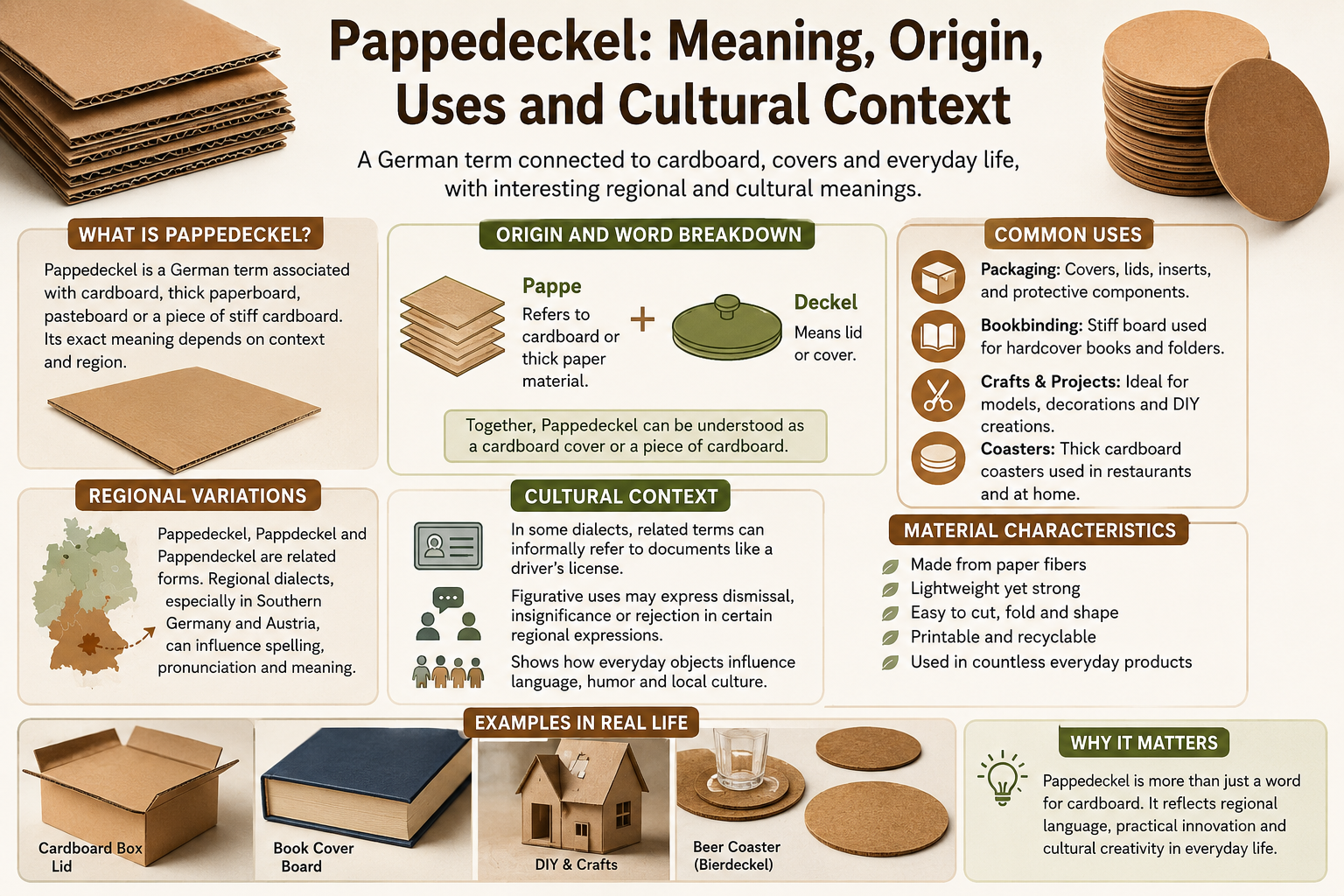
Pappedeckel: Meaning, Origin, Uses and Cultural Context
Pappedeckel is a distinctive German term that has attracted interest for its unusual spelling, regional associations, and connection to everyday materials. The word is closely related to German terms for cardboard, pasteboard, covers, and other stiff paper-based materials. Depending on where it is used and the context surrounding it, Pappedeckel can have slightly different interpretations.
At a basic level, the word can be understood through its two components. “Pappe” refers to cardboard or a thick paper-based material, while “Deckel” generally means lid or cover. However, translating Pappedeckel simply as “cardboard lid” does not fully explain the word. Its related forms and regional uses give it a broader linguistic and cultural background.
What Is Pappedeckel?
Pappedeckel is associated with cardboard, thick paper, paperboard, pasteboard, or a piece of stiff cardboard. The exact meaning depends on how the word is being used.
In everyday language, it may describe a simple cardboard piece or cover. In another setting, it could relate to a protective cardboard component, a book cover, or another object made from stiff paper material.
The term is particularly interesting because it is not best understood as the name of one specific modern product. Instead, it belongs to a wider group of German words connected with cardboard and covers.
This distinction is important because different explanations of Pappedeckel can appear contradictory when they are actually describing different contexts.
Understanding the Word Pappedeckel
The word becomes easier to understand when its parts are examined separately.
Pappe
“Pappe” is associated with cardboard or thick paper. It generally describes a material that is thicker and more rigid than ordinary writing paper.
Cardboard can be manufactured in different thicknesses and qualities. It may be used for packaging, bookbinding, crafts, displays, protective layers, and numerous other purposes.
Deckel
“Deckel” is the German word commonly associated with a lid or cover.
German uses this word in many compound terms to describe something that closes, protects, or covers another object.
Combining Pappe and Deckel creates a word that naturally suggests a cardboard cover or cardboard lid. However, the actual vocabulary surrounding Pappedeckel is broader than this literal interpretation.
Pappedeckel and Pappdeckel
One reason the term can be confusing is that several similar spellings exist.
Pappdeckel is a closely related and more commonly documented German form. Pappendeckel is another form that can be encountered, particularly in regional contexts.
Pappedeckel can therefore be understood as part of a larger group of words rather than as an isolated term.
These variations demonstrate an important feature of German: regional speech can influence spelling, pronunciation, vocabulary, and meaning.
A person familiar with one German dialect may immediately recognize a term that sounds unusual to someone who primarily speaks Standard German.
Is Pappedeckel Standard German?
The answer depends on the exact spelling and region.
The forms Pappdeckel and Pappendeckel are established in German vocabulary, while Pappedeckel can appear in regional or informal usage.
This does not make the term meaningless or incorrect. It simply means that language users should consider the environment in which the word appears.
Regional German contains thousands of expressions that may not be common in formal writing but remain perfectly understandable to people from a particular area.
Pappedeckel is an example of this broader relationship between Standard German and regional speech.
Regional Variations of Pappedeckel
German-speaking regions have developed distinctive dialects over centuries.
Southern Germany, Austria, Switzerland, and neighboring areas have vocabulary that can differ from the language commonly taught in international German courses.
Regional forms related to Pappedeckel can therefore have different pronunciations and meanings.
A word that simply refers to cardboard in one location may become part of an expression or nickname in another.
This is why it is difficult to give one definition that covers every possible use.
The regional character of the term is actually one of the most interesting parts of its history.
What Does Pappedeckel Refer To?
Depending on context, Pappedeckel may be associated with several types of objects or materials.
These can include:
- Cardboard
- Thick paperboard
- Pasteboard
- A cardboard sheet
- A cardboard cover
- A protective cardboard piece
- A stiff bookbinding material
- A cardboard lid
- Certain regional or dialect expressions
These meanings are related because they all involve stiff paper-based material or an object made from it.
The surrounding sentence is therefore important when determining the most appropriate interpretation.
Pappedeckel in Packaging
Cardboard has been used in packaging for generations.
It is lightweight, relatively inexpensive, easy to print, and available in many different thicknesses. These properties make paper-based materials useful for boxes, sleeves, covers, inserts, dividers, and protective components.
A cardboard cover can protect a product from dust, scratches, or minor impacts. It can also provide a convenient surface for instructions, branding, labels, and other information.
In modern packaging discussions, terms associated with cardboard sometimes appear alongside conversations about reducing plastic use.
However, Pappedeckel should not be treated as the name of one particular packaging system. Its meaning is broader and depends on context.
Pappedeckel and Cardboard Covers
The connection between the word and covers is easy to understand.
A cover protects something underneath it. When the cover is made from stiff cardboard, it can provide both physical protection and structural support.
Cardboard covers can be found in:
- Books
- Folders
- Boxes
- Product packaging
- Storage containers
- Display materials
- Educational products
- Craft projects
This broad range of applications explains why words associated with cardboard covers can develop different meanings over time.
Pappedeckel in Bookbinding
One traditional application of stiff cardboard is bookbinding.
Hardcover books require a strong material to give the covers their shape and rigidity. Specialized board materials can be covered with paper, fabric, leather, or other decorative surfaces.
The cardboard itself may not be visible once the book has been completed, but it plays an important structural role.
This connection makes Pappedeckel-related vocabulary relevant to traditional printing and bookmaking as well as modern packaging.
Pappedeckel and Craft Projects
Cardboard is also one of the most accessible materials for crafts.
Children, students, artists, designers, and hobbyists can transform cardboard into models, decorations, organizers, signs, templates, and prototypes.
Its popularity comes from several practical characteristics.
It can be cut with simple tools, folded into shapes, glued together, painted, decorated, and printed.
For small projects, cardboard can also provide a low-cost way to experiment with shapes and structures before using more expensive materials.
Pappedeckel and Beer Coasters
Another cultural association involves German beer coasters.
Beer coasters are commonly made from thick absorbent board and are familiar in restaurants, pubs, and beer gardens.
The German word more specifically associated with a beer coaster is “Bierdeckel.” However, some regional or informal discussions may connect cardboard-related vocabulary with these objects.
This distinction is worth explaining because Pappedeckel should not automatically be translated as “beer coaster.”
A beer coaster is one possible cultural association, not the universal meaning of the term.
Pappedeckel in Regional Expressions
Language often turns ordinary objects into figurative expressions.
Cardboard is a familiar material, so it is not surprising that regional German speakers have developed humorous or figurative uses for words from the Pappedeckel family.
In some dialect environments, related expressions can refer to documents or objects based on their physical appearance or material.
Such uses are difficult to translate word-for-word because their meaning comes from the expression as a whole.
This is an excellent example of why learning individual German words is sometimes not enough. Understanding regional culture and context can be equally important.
Why Context Changes the Meaning
Imagine encountering Pappedeckel in three different situations.
If the discussion concerns packaging, the word may refer to a cardboard cover or component.
If the conversation concerns books, it may be connected with stiff board used for covers.
And if it appears in a regional expression, the intended meaning could be figurative.
The word itself does not provide enough information in every situation.
This is common in natural language. Words develop meanings through repeated use, and regional communities can give familiar objects additional meanings.
Pappedeckel vs. Cardboard
It may be tempting to translate Pappedeckel simply as “cardboard.”
That can work in some contexts, but it is not always precise.
Cardboard describes a broad category of paper-based materials. Pappedeckel may instead refer to a particular piece, cover, or object made from that material.
Depending on the context, possible English translations could include:
- Cardboard
- Paperboard
- Pasteboard
- Cardboard piece
- Cardboard cover
- Board
- Cardboard lid
The best translation should describe the role of the object rather than relying on a single fixed English equivalent.
Why Pappedeckel Has Different Spellings
Regional speech is one major reason for variations.
Languages naturally change as people pronounce words differently, shorten sounds, add sounds, or adapt words to local speech patterns.
German dialects are particularly diverse.
A word can therefore have a standard written form alongside several regional forms.
Pappedeckel, Pappdeckel, and Pappendeckel illustrate how closely related forms can exist within the same language family.
Rather than seeing every spelling variation as a completely different word, it is more useful to examine their historical and regional relationship.
Is Pappedeckel a Modern Term?
The underlying vocabulary is not new.
Cardboard and pasteboard have been used for a very long time in books, packaging, crafts, household products, and other applications.
What is relatively modern is the increased international attention surrounding unusual words.
People can now encounter regional expressions online, search for unfamiliar terms, and discuss them with speakers from other countries.
As a result, words that once remained mostly within a particular linguistic community can become topics of international curiosity.
Pappedeckel and Sustainability
Modern discussions about cardboard often include environmental considerations.
Paper-based packaging can offer advantages in situations where recyclable or renewable materials are appropriate.
However, cardboard is not automatically environmentally friendly simply because it comes from paper fibers.
Its environmental impact can depend on:
- The source of the fibers
- Recycled content
- Manufacturing processes
- Energy consumption
- Water use
- Coatings
- Adhesives
- Inks
- Transportation
- Recycling facilities
- Contamination after use
For example, a heavily coated or laminated paper product may be more difficult to recycle than a simple untreated cardboard piece.
Therefore, Pappedeckel-related packaging should be evaluated according to its actual material and disposal system.
Cardboard in Modern Manufacturing
Today, cardboard and paperboard are highly engineered materials.
Manufacturers can produce boards with different combinations of:
- Thickness
- Strength
- Flexibility
- Surface finish
- Moisture resistance
- Printability
- Folding performance
Some products are designed to remain rigid, while others are manufactured specifically for folding.
This makes cardboard suitable for applications ranging from simple household packaging to sophisticated commercial product designs.
The traditional idea of a simple piece of cardboard has therefore evolved into a broad materials industry.
Why German Compound Words Are Interesting
Pappedeckel also provides a useful example of German compound-word formation.
German frequently combines two or more words to create a new noun.
When learners see a compound word, breaking it into smaller components can often provide clues about its meaning.
For Pappedeckel, recognizing Pappe and Deckel immediately gives the learner a useful starting point.
However, compounds should not always be translated literally.
Historical usage, regional dialects, and cultural associations can change the meaning of a compound beyond what its individual components suggest.
Common Misconceptions About Pappedeckel
Pappedeckel Always Means Cardboard Lid
Not necessarily. The related vocabulary has broader connections with cardboard, pasteboard, and pieces of stiff paper.
Pappedeckel Always Means Beer Coaster
No. Beer coaster has a more specific German term, Bierdeckel.
Pappedeckel Is Used Everywhere in Germany
Not necessarily. Regional vocabulary varies, and some forms may be more familiar in particular areas.
Pappedeckel Is the Only Correct German Form
No. Related forms such as Pappdeckel and Pappendeckel are important when researching the word.
The Word Has Only One Translation
No. The appropriate English translation depends on whether the context concerns material, packaging, bookbinding, or a regional expression.
How to Understand Pappedeckel Correctly
The easiest way to understand the word is to use a three-part approach.
First, identify the spelling.
Second, determine the regional or linguistic context.
Third, examine the sentence in which the word appears.
For example, a formal German text may favor a different form from a regional conversation.
Similarly, a sentence about a book may require a different English translation from a sentence about packaging.
This approach provides a much more accurate understanding than relying on a single-word translation.
Frequently Asked Questions
What does Pappedeckel mean in English?
Depending on context, it can be translated as cardboard, piece of cardboard, paperboard, pasteboard, cardboard cover, or cardboard lid.
Is Pappedeckel the same as Pappdeckel?
They are closely related forms. Pappdeckel is a well-established German form, while Pappedeckel can occur in regional or informal usage.
What is Pappendeckel?
Pappendeckel is another related German form associated with cardboard, pasteboard, or thick paper-based material.
Does Pappedeckel mean beer coaster?
Not specifically. The German word Bierdeckel is more directly associated with a beer coaster. Pappedeckel may have a contextual association with cardboard coasters in some discussions.
Why does Pappedeckel have different meanings?
Regional dialects, historical development, compound-word formation, and figurative usage can all influence its meaning. The surrounding context is therefore important.
Conclusion
Pappedeckel is much more interesting than its simple appearance suggests. At its core, it belongs to a German vocabulary family associated with Pappe, or cardboard-like material, and Deckel, meaning a lid or cover. Related forms such as Pappdeckel and Pappendeckel help explain the term’s broader linguistic background.
The word can be connected with cardboard pieces, covers, packaging, bookbinding, crafts, and regional expressions. Its meaning may also change according to dialect and context.
Rather than defining Pappedeckel as one specific object, it is more accurate to view it as part of a broader German and regional vocabulary surrounding cardboard and covers. Its variations demonstrate how languages evolve and how everyday materials can become part of regional expressions and cultural traditions.
For anyone interested in German vocabulary, dialects, packaging, or everyday culture, Pappedeckel offers a fascinating example of how a seemingly ordinary word can have a surprisingly rich linguistic history.