Duaction: Meaning, Benefits, Principles, Examples, and How It Works
Duaction is a modern learning concept that connects knowledge with immediate action. Instead of learning something through theory and waiting until later to practice it, Duaction encourages people to understand an idea and apply it at nearly the same time. The approach focuses on turning information into practical skills through participation, experimentation, feedback, and continuous improvement.
The term has become increasingly associated with action-based learning, professional development, and practical skill building. While Duaction is not a universally standardized academic framework, the idea behind it is straightforward: people can strengthen their understanding when they actively use what they learn.
What Is Duaction?
Duaction can be understood as the combination of learning and doing within the same process. The concept is commonly explained through the ideas of “dual” and “action,” emphasizing two connected activities that reinforce one another.
In a conventional learning process, a person may first study a subject, memorize important information, complete an examination, and only later attempt to use that knowledge. Duaction reduces the gap between learning and application.
A simple way to understand the concept is:
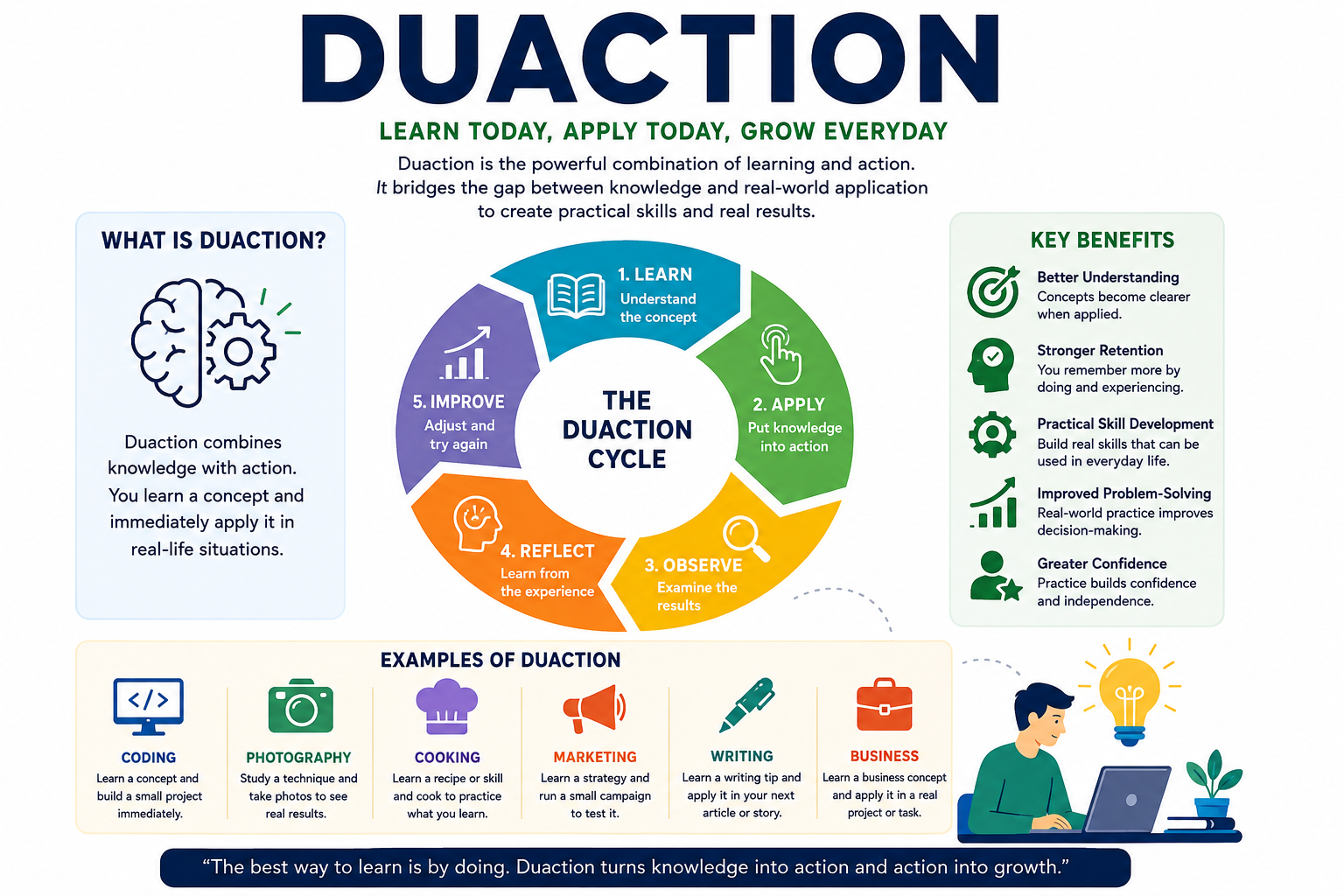
Learn → Apply → Observe → Reflect → Improve
For example, someone learning web development might read about HTML elements and immediately create a small webpage. While building the page, the learner discovers errors, corrects them, and gains a practical understanding of the subject.
This makes learning an active experience rather than something based entirely on reading, listening, or memorization.
How Does Duaction Work?
The Duaction approach can be viewed as a continuous learning cycle.
1. Learn a Concept
The first step is understanding a particular idea, technique, principle, or process. The information should generally be focused and relevant to the task that follows.
For example, a student learning photography may first study exposure, shutter speed, and aperture.
2. Take Immediate Action
Instead of stopping after studying the concept, the learner uses it in a practical situation.
The photography student might immediately take several photographs while changing the camera settings.
3. Observe the Result
Action produces an outcome. The learner can examine what worked, what failed, and what needs improvement.
This step is important because practical results often reveal details that are difficult to understand through theory alone.
4. Reflect on the Experience
The learner considers why a particular result occurred. Reflection connects the practical experience back to the original knowledge.
5. Adjust and Try Again
The learner changes the approach and performs the task again. This creates a repeating cycle in which each attempt contributes to greater understanding and skill.
Key Principles of Duaction
Several principles commonly describe this approach.
Active Participation
Duaction places the learner in an active role. Instead of simply receiving information, the learner participates in activities, projects, experiments, simulations, or real-world tasks.
Active participation can make learning more engaging because the individual has a direct role in the outcome.
Immediate Application
One of the most important characteristics is applying knowledge soon after learning it. The shorter the distance between understanding and practice, the easier it can be to connect an abstract concept with a real situation.
Learning Through Experience
Experience provides information that theoretical study may not provide on its own. Practical activities expose learners to mistakes, unexpected results, limitations, and real-world decisions.
Feedback and Reflection
Feedback helps learners understand whether their actions are producing the desired results. Reflection then allows them to identify what they should continue, change, or improve.
Continuous Improvement
Duaction is not based on achieving perfection during the first attempt. Instead, it encourages repeated learning and adjustment.
A person learns something, uses it, evaluates the outcome, and uses that experience to make the next attempt better.
Duaction vs. Traditional Learning
Duaction does not necessarily mean that traditional education is ineffective. Rather, it adds a stronger practical component to learning.
| Traditional Learning | Duaction Approach |
| Theory may come before practice | Theory and practice are closely connected |
| Greater emphasis on receiving information | Greater emphasis on participation |
| Practice may happen later | Application happens quickly |
| Feedback can be delayed | Feedback is incorporated into the learning cycle |
| Memorization can be prominent | Skill development receives greater attention |
| Learning may be classroom-centered | Learning can involve real-world activities |
The strongest learning environment may combine both approaches. Theory provides the foundation, while practical action helps learners understand how that knowledge works in real situations.
Benefits of Duaction
Better Understanding
Using information in a practical setting can make complicated ideas easier to understand. Instead of thinking about a concept only in abstract terms, learners can see how it behaves in practice.
Stronger Knowledge Retention
Information connected with an activity, result, or personal experience may be easier to remember than information encountered only through passive study.
For instance, a student who performs an experiment may remember the underlying scientific principle more clearly because the concept is connected to something they actually observed.
Practical Skill Development
Knowledge and skill are not always the same thing. Someone can understand how a task should be performed without being capable of performing it effectively.
Duaction helps close this gap by encouraging repeated practical use.
Greater Confidence
Successful practice can gradually increase confidence. Even mistakes can be valuable because they show learners what needs to change.
As people become familiar with the process of trying, evaluating, and improving, they may become more comfortable handling unfamiliar situations.
Improved Problem-Solving
Real tasks rarely follow perfectly predictable instructions. Learners may need to make decisions, identify problems, test solutions, and adapt their approach.
These experiences can strengthen problem-solving and critical-thinking abilities.
Increased Engagement
People are often more engaged when they can see the purpose behind what they are learning. Practical tasks give learners an opportunity to produce something, solve a problem, or achieve a measurable result.
Examples of Duaction in Everyday Life
Duaction does not have to require a formal classroom or specialized training program. It can be applied to many everyday activities.
Learning a New Language
Instead of studying vocabulary for weeks before using it, a learner can study a few words and immediately use them in sentences or conversations.
Learning Coding
A beginner can study a programming concept and then create a small program using that concept. Errors become part of the learning experience.
Learning Cooking
Reading about a cooking technique becomes more useful when the learner practices it while preparing a meal. The person can observe texture, timing, temperature, and taste and adjust accordingly.
Learning Photography
A photographer can study composition and immediately take photographs using the technique. Reviewing the results provides practical feedback.
Developing Business Skills
An entrepreneur can study a marketing principle and test it on a small campaign. The results provide information that can guide the next campaign.
Improving Writing
A person learning better writing techniques can study a principle and immediately use it in an article, report, or short piece of content. Reviewing the finished work can reveal areas for improvement.
Duaction in Education
Educational institutions can incorporate this approach through project-based activities, laboratory work, simulations, group assignments, field experiences, and practical demonstrations.
For example, instead of only reading about environmental science, students might collect local observations, analyze information, and develop a small project based on their findings.
The teacher’s role can also change. Rather than simply delivering information, the teacher can provide guidance, feedback, questions, and practical challenges.
This does not eliminate theoretical education. Instead, it creates a connection between theoretical knowledge and practical experience.
Duaction in the Workplace
The same concept can be useful in professional development.
Employees often receive training but may struggle to remember how to apply it once they return to their regular responsibilities. A more action-oriented approach can allow workers to learn a new procedure and practice it under appropriate supervision.
For example, an employee learning new software could follow a short lesson and then use the software to complete an actual or simulated work task.
This approach can make training more relevant because employees immediately see how new knowledge relates to their responsibilities.
Duaction and Technology
Technology can make action-based learning easier to implement. Interactive platforms, simulations, virtual environments, educational software, and AI-assisted tools can provide opportunities to practice concepts and receive rapid feedback.
For example, a learner studying programming can write and test code immediately. Someone learning a language can practice conversations. A business student can work with simulated scenarios.
Technology does not automatically create effective learning, but it can provide environments where learning and application happen closer together.
Is Duaction the Same as Multitasking?
No. Duaction should not be confused with ordinary multitasking.
Multitasking generally means attempting to handle several tasks at the same time, which can divide attention. Duaction is better understood as combining two closely related activities that support one another.
For example, learning a programming concept while using it to build a small project is connected learning and action. Checking email while watching a lesson would simply be multitasking.
The important distinction is purposeful connection.
Challenges of the Duaction Approach
Although the approach offers several potential advantages, it also has limitations.
First, beginners may make mistakes when applying information before fully understanding the fundamentals. Some subjects require a strong theoretical foundation before practical work can be performed safely or accurately.
Second, practical activities require planning and resources. Schools, businesses, and training organizations may need appropriate equipment, instructors, software, or time.
Another challenge is poor feedback. If learners practice incorrectly without receiving useful guidance, they may reinforce bad habits rather than improve.
For these reasons, Duaction works best when practical action is supported by clear instruction, appropriate supervision, useful feedback, and reflection.
How to Apply Duaction to Your Own Learning
You can introduce the approach without completely changing your learning routine.
Start with one small concept rather than trying to practice everything at once.
Next, create a simple activity that uses the concept. Keep the task realistic and manageable.
After completing it, review the outcome. Ask yourself:
- What did I understand correctly?
- Where did I make a mistake?
- What surprised me?
- What should I change next time?
- What additional knowledge do I need?
Then repeat the process.
This creates a practical learning loop in which every attempt provides new information.
Why Duaction Matters Today
Modern education and professional development increasingly emphasize skills that can be transferred into real situations. Memorizing information can be useful, but people also need to know how to analyze problems, communicate, adapt, make decisions, and use their knowledge.
Duaction provides a simple way of thinking about this challenge. It encourages people to reduce the gap between knowing and doing.
The concept can also support lifelong learning. Instead of viewing learning as something that ends after school or formal training, people can treat everyday activities as opportunities to acquire knowledge, test ideas, receive feedback, and improve.
Final Thoughts
Duaction represents a practical approach to learning in which knowledge and action work together. Its central idea is simple: do not leave application until some distant future when you can safely and meaningfully practice what you are learning now.
Whether someone is studying, developing professional skills, learning a creative activity, or solving a practical problem, the cycle of learning, acting, reflecting, and improving can make the experience more meaningful.
Duaction should not be viewed as a replacement for every traditional learning method. Instead, it can complement theory by giving learners opportunities to turn information into usable skills. When thoughtful instruction is combined with purposeful practice and feedback, learning becomes more connected to real-world performance.